


|
|
|
|
|
|
|
| |
| 12-OCT-2007 | |
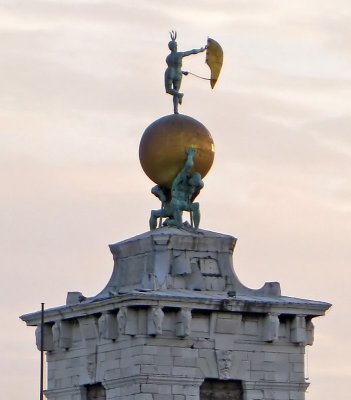
From Wikipedia: The buttressed square tower of the old custom house supports two bronze
Atlases who shoulder a globe on which the Goddess Fortuna, sculpted in the form of
an elegant bronze weathervane, holds a gilded sail to the breeze.
The Punta della Dogana
The old customs house, dwarfed by the massive dome of the Maria della Salute, is located
on the furthermost point of the Punta della Dogana, the wedge-shaped peninsular at the
entrance to the Grand Canal. In the days when Venice was a major commercial centre, the
customs house controlled access to the Grand Canal and the San Marco docks. Since
virtually all taxes were raised by charging import duties on commodities, the state had to
search ships and check cargoes in order to collect its revenues.
The original 14th century watch tower was constructed for the purpose of preventing tax
evasion. It was replaced by the present structure in 1690. The customs house is typical
of the baroque period. The arrangement of its exterior columns varies between stories in
order to create a pattern of eye-catching contrasts.
Its buttressed square tower supports two bronze Atlases who shoulder a gilded globe
on which the Goddess Fortuna, sculpted in the form of an elegant bronze weathervane,
holds a gilded sail to the breeze.
The Dogana di Mare is splendidly ornate but by the late 17th century Venice was no
longer able to conceal its decline.
By the time the Dogana di Mare was completed, the city had been bled dry by a succession
of expensive wars and deadly plagues, and had lost much of her trading empire. Foreign
merchants, particularly the British and Dutch, had established global trade routes which
bypassed the eastern Mediterranean. As a result, Venetian merchants lost their commercial
monopolies and were undercut, even in their home markets. Venice was slowly going bankrupt.
IMG_2661-W.jpg
These images are copyright protected