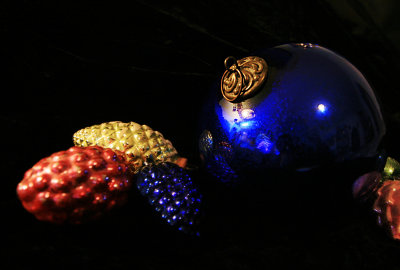
Just what is a Christmas Kugel? They’re the thicker,
heavier ancestors of the modern Christmas ball. The origins of these magnificent,
silvered-glass ornaments can be traced at least to the late 1840s, when the first
advertisement for them was recorded. Kugel means “ball” in German (hence the term’s
use in Yiddish to describe the noodle pudding that originally was made in a rounded
pan); the first kugel ornaments are products of the historic glass-blowing hub of
Lauscha, in central Germany’s Thuringian Forest.
On some of the historic balls, cylindrical pikes left over from the glassblowing
process extend from the crown. But those balls topped with permanently attached,
ornate brass caps, complete with brass rings for hanging, are the most valuable.
The caps are the identifying mark of an antique kugel, along with the distinctive
brilliant colors and thick glass skin. For each type of kugel, there are diferrent
methods for how the glass was made, the color achieved. The reds, for example,
are blown clear first, then dipped in red glass; traditionally, silver nitrate
is poured inside to produce a mirrored effect.
Kugels were seen throughout Europe from the time they were made. But a decade later,
the ornaments’ popularity soared in England and the United States, a reflection of
the growing popularity of mirrored glass in English-speaking nations. Larger models
of the German imports were typically hung from ceilings or archways in people’s home.
But in 1840, Queen Victoria married Albert, who introduced her to Christmas trees.
The trees at that time were only tabletop-sized, and decorated with homemade crafts,
toys, cranberries and cookies, since glass was a luxury item. But as kugels were made
smaller and more manageable, they migrated from walls to these tabletop evergreens’
branches, at least in Europe. As for kugels’ crossing the Atlantic, F. W. Woolworth
is said to have brought the shiny glass balls to American shores in 1880, where they
became all the rage; Woolworth’s supply quickly sold out.
Yet, experts agree that in an attempt to broaden the choices of kugels, manufacturers
may have sabotaged their own growth. “In the 1870s, they started making shapes –
strawberries, grapes, pears,” McManus notes. “These were much heavier, which reduced
their popularity.” As the weight of the glass spheres became more of an issue,
lighter ornaments began to be made outside Germany, and became more widely adopted.
“Thin-walled ornaments were the end of kugels,” But for a few lucky collectors,
the richly colored kugels still shine. Antique kugels are treasured as family
heirlooms in more than a few homes, and tend to survive because they don’t break
as easily as do modern Christmas balls. To be considered a true kugel, an ornament
must have been made prior to about 1940; after that, the lighter ones became more
commonplace.