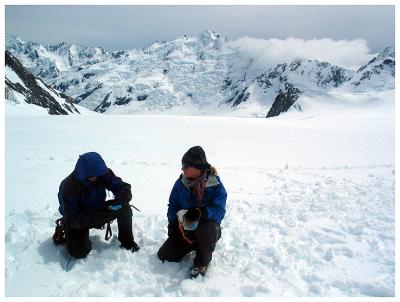
The weather was still subpar when we woke up on the third day, but had improved (the rain changed over to snow and the wind died down). In the morning we practiced abseiling over the stair bannister using different knots as backup devices. After abseiling we shoveled snow off the deck and stairs outside -- impressive how much snow fell in a day. After lunch the weather cleared and we headed outside. We used the flat area where the planes/helicoptors land to practice using the avalanche transceivers. Avalanches are more frequent in the winter time, but can still occur in the summer so we all wore transceivers whenever we left the hut. Lisa buried her transceiver and we practiced using ours to find the buried one. When we wore the transceivers they were plugged in and always sending out a signal. To find the buried one we turned ours to receive and used the beeping noises and a grid search to locate it.
Next we hiked across the way to find a slope suitable for practicing self arrest. Along the way Lisa peeked in to a few crevasses. When she walked up to the crevasse Steve and I were behind her holding the rope tight. She gave us a crash course in crevasse rescue in case she went in, which involved digging in our axe, holding the rope, and waiting until she prussiked out. Thankfully, a crash course we didn't need.
We found a slope and worked on self arrest. We started out on our stomachs sliding down feet first. This is the easiest position from which to stop a fall and we just dug in our ice axe while holding it across our body. From here we practiced from all positions -- including going down the mountain slope head first on our back. I knew everything was fine, but it was a little disconcerting to be sliding down a mountain and not being able to see where you are going. We were able to stop ourselves from each position and it was a fun exercise.