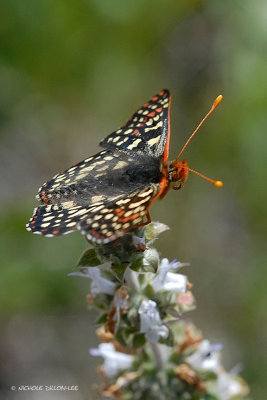
I came across this cute butterfly at Santa Teresa Park in San Jose by accident, on a hike to locate wild flowers I saw some bees buzzing around some Owl's Clover and while photographing them I found the butterfly. When I showed it to my Mother in law she informed me of the species and how rare it is so I will be going back to see if I can get more shots soon ;-) For now, here is some information I found at the following website http://essig.berkeley.edu/endins/baycheck.htm
Scientific Name: Euphydryas editha bayensis
Date of listing: 1987
Federal Status: Threatened
State Status: None
It is ironic that the insect on which Paul Ehrlich based his idea of metapopulations, now a paradigm for conservation of endangered species, has since become threatened itself. The Bay Checkerspot Butterfly has experienced serious declines in its populations since the mid-1980s. Because this species has long enjoyed the attention of numerous biologists, its decline was quickly realized prompting its listing as threatened in 1987.
The Bay Checkerspot has an interesting life cycle which may include a few different host plants. Following mating in mid-spring, the female butterflies lay their eggs on a native plantain, Plantago erecta. The eggs hatch and the larvae feed on this host until either they have developed to a point at which they may enter dormancy or the host has begun to dry up from the summer heat. If the plantain is not sufficient for development the larvae may move onto one of two species of owl's clover (Castilleja densiflorus or C. exserta) which remain palatable for a longer period. Generally, one season is not sufficient for completion of development and the larvae must enter dormancy until the following winter when the rains allow plant growth to begin again. The larvae then emerge to feed for a little longer, pupating in late winter. The adults emerge shortly thereafter.
Populations of the Bay Checkerspot historically inhabited numerous areas around the San Francisco Bay including the San Francisco peninsula, the mountains near San Jose, the Oakland hills, and several spots in Alameda County. Most of these have apparently disappeared due to the explosive development of the Bay area in the past century. Populations are now known only from San Mateo and Santa Clara counties. Changing disturbance regimes (i.e. fire, grazing) as well as introduced grassland plants have caused declines in host plant populations. In Santa Clara County much of the butterfly's habitat is on property owned by a landfill corporation. An agreement worked out among the owner, the city of San Jose, and conservation advocates has resulted in the protection of much of this habitat in exchange for permitted, conscientious development of a small portion of it. In addition, the landowner has provided funding for the establishment of a butterfly preserve and for research towards successful management of the Bay Checkerspot.



ERROR: 500
NOTES: [hset] LOADING Redis is loading the dataset in memory, at /usr/local/share/perl5/Redis.pm line 268. ,
PBASE_ENV: production
Try Again:Go Home