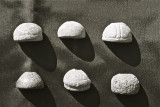
Spindle whorls, or malacates in both Spanish, are perforated disks used in the production of spun fiber.
Handspinning involves a wooden spindle and whorl, with the whorl acting as a flywheel to maintain inertia when the spindle is given a sharp twist. Spinning in pre-Columbian Mesoamerica was done using two principal methods: "drop-spinning," where the spindle and whorl were spun from a standing position, drawing and twisting the fiber as the spindle dropped to the ground; and "supported-spinning," where the tip of the spindle was spun in a small bowl.