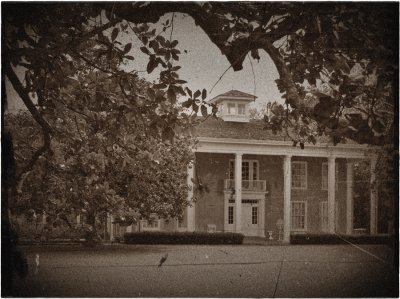
Current photo with Antique treatments
Varner-Hogg Plantation’s history began in 1824 when Virginia native Martin Varner purchased 4,428
acres in present day Brazoria County, Texas. They brought two enslaved men to farm and raise livestock
on a small scale and establish a rum distillery.
In 1834, Martin Varner sold the property to Columbus R. Patton of Kentucky. Between 40 and 60 slaves
lived and worked on the plantation, known then as Patton Place. With bricks they made by hand, the slaves
constructed the plantation house, smokehouse, sugar mill and their own quarters. With their labor, Columbus Patton
built a successful and larger than average sugarcane enterprise complete with a two-story mill. His long,
open relationship with his slave Rachel became a point of contention in the community.
Patton successfully managed the plantation until November 1854 when his family had him declared
insane. He was placed in an asylum in South Carolina, where he died of typhoid fever in 1856.
Patton’s estate became mired in probate court when his family attempted to overturn his will.
After a prolonged court battle, Rachel was given her freedom and the annual stipend.
Until 1901, the site changed ownership several times. At one point, owners used convicts through a
leasing program as laborers. In 1875, however, state investigators found “particular cruelty” toward convicts.
In 1876, the Texas Land Company purchased the plantation and gradually switched the site’s focus
to ranching. The majority of the laborers, now cowboys, were African Americans.
The plantation sustained major damage in the 1900 hurricane. Many of the original buildings, including
the sugar mill, were destroyed. In 1901, former Texas Gov. James Stephen Hogg purchased the land, convinced
that large amounts of oil lay beneath the surface. Hogg died in 1906. but the Hogg heirs struck oil,
making them all very wealthy.
In 1919, the Hoggs made several modifications to the house producing its current appearance.