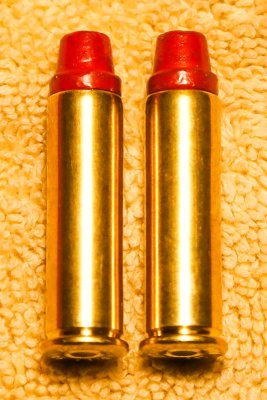
This started out as a simple documentation of a reloading experiment and turned into a photography experiment. I have been honing my reloading technique. Recently I went through an exhaustive case preparation exercise for .357 magnum target loads. I had a brand new lot of brass which I trimmed to 1.274 +/- .001 inches. That took a while. The objective of this exercise was to minimize the variability in muzzle velocity. That is something I can measure with a chronograph. I really can't measure accuracy because I am a terrible shot. I do know from experience that muzzle velocity changes the point of impact quite a bit. Faster rounds tend to hit the target lower. With a lot of variability you get what's called vertical stringing. My friend John Cooper understands all this stuff. I am still learning.
Anyway, I wanted to get some photographs for documentation. So I put two rounds out on a towel and fired off a couple frames with my trusty G5X. I looked at the photos very carefully in Lightroom and found that the towel was in good focus, but the rim of the bullet was not. So I tried it again figuring that I messed it up the first time. Same result. Then I got out my 5D Mk4. Pretty much the same result. Then my brain came to life. What about the DOF (depth of field). I grabbed my handy calculator and found that for the settings I was using the DOF was +/- 0.03 inches. Who knew? The width of the bullet is 0.357 inches. So I tried out plan B, C, D and E. The final was using the macro feature of the 24-105 lens. That gave the best result. All this was hand held. If I want to do this in the future I am going to use a tripod for sure.
I can remember instances in the past where I was trying to get a nice shot of something up close and always being disappointed in the result. Now I know the underlying problem and can do something about it.
|