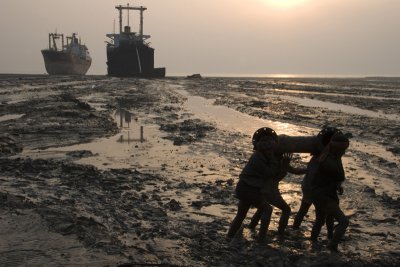
There are a handful of places around the world where ships that have reached the end of their useful lives are scrapped. It is a dirty, dangerous and labor intensive process, so these tend to be countries whose cheap labor and weak safety and environmental regulations allow them to recycle the ships at low cost and make a profit on the scrap metal: Vietnam, India, Pakistan and Bangladesh. Proper conditions for beaching large ships are also essential. The beach used for shipbreaking outside of Chittagong, Bangladesh has ideal seafloor topography and tidal characteristics: unusually high tides during new and full moons but small tidal variations the rest of the month, wide mud flats on which to work and move large sections of ships, and no surf. Once a purchase is negotiated, the ship rides anchor until the next new or full tide. Then a specialist captain takes over, revs the engine up to maximum rpm and rams the ship at full speed into the beach, not laying off the throttle until the ship will move no further or the engine dies. I was lucky enough to witness this event, and it is quite a sight to see a massive cargo ship grinding to a halt as the prop churns mud into the air. Chittagong is where the world’s largest ships are scrapped: cruise ships, container ships, oil tankers, dry bulk carriers.
In my research, I learned that Greenpeace is a vociferous opponent of the shipbreaking industry, since during the process myriad toxic materials – oil, asbestos, arsenic and heavy metals - are spilled onto the beach. They also cite the great danger of working the yards – these men are literally tearing apart huge ships by hand with plasma torches. Large sections of ship fall to the ground and the workers, wearing little protective gear, can be maimed or crushed when things do not fall as planned; powerful winches on the shore pull ship sections off the beach with heavy steel cables that sometimes snap under extreme tension and cut men in half. The workers are paid about $2 per day. Because of Greenpeace’s campaigns, foreigners are usually kept away from the yards. I tried visiting the yards in Gujarat, India and was told by the local police that a white man would not even be allowed into the town near the yards. I had better luck in Bangladesh.