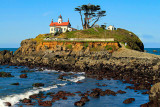
Battery Point Light was one of the first lighthouses on the California coast. Rugged mountains and unbridged rivers meant coastal travel was essential for the economic survival of this region. In 1855, Congress appropriated $15,000 for the construction of a lighthouse on the tiny islet, which is connected to Battery Point by an isthmus which is visible, and can be traversed on foot, at low tide. Although not included in the 1852 contract by the United States Lighthouse Service for the first eight west coast lighthouses, the Battery Point Lighthouse was actually lit ten days before the Humboldt Harbor Lighthouse, the last of the original eight to become operational. The fourth-order Fresnel lens was lit in 1856. The lighthouse was automated in 1953, and a modern 14.8-inch (375 mm) lens replaced the fourth-order Fresnel lens. Theophilis Magruder was the station's first keeper; Wayne Piland was its last before automation in 1953. The 1964 Alaska earthquake, the strongest earthquake ever recorded in the northern hemisphere, caused a tsunami. The lighthouse survived.