


|
|
|
|
|
|
|
| |
Welfare groups using shut ‘sento’ to push local ties, prevent frailty
by TATSUO KANAI/ Staff Writer
July 13, 2025
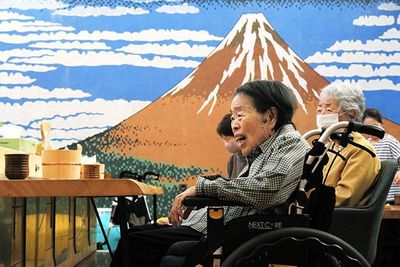
Elderly citizens watch TV at Bara-no-Yu, a former sento repurposed into a day care service institution, in Matsumoto, Nagano Prefecture, on April 24. (Tatsuo Kanai photo
Many closed-down “sento” public bathhouses across Japan have been reborn as cafes or even “izakaya” pubs. But a few are now being used for welfare services while maintaining the original association with cleanliness and companionship.
The Bara-no-Yu (Rose bath) is one such place.
Located near Matsumoto Castle in Matsumoto, Nagano Prefecture, Bara-no-Yu closed in 2021 due mainly to equipment deterioration.
The beloved sento had a history of 66 years and was among the largest public bathhouses in Matsumoto. After its closure, the facility remained idle for years.
But at 9 a.m. on a recent day, elderly people were chatting and watching TV in what was once the washing area of Bara-no-Yu. They were seated under a wall mural of a red Mount Fuji, a fixture decoration in Japan’s sento tradition.
A man in his 80s was soaking in a bathtub next door and being washed by a worker.
“It feels so good being here that I can forget all the nasty things,” the octogenarian said.
Camomile House, a welfare service provider, refurbished the sento building in October 2024 and opened a day care service center within it.
The group had been operating three other day care centers at vacant houses in the city. Camomile House drew on that know-how in reviving the public bathhouse.
Yuka Wada, who administers Bara-no-Yu, said that when she was in her 20s she worked at a large-scale day care service center, where workers would wash bathers in a cramped bathhouse with a changeover interval of only several minutes.
“This is like potatoes being washed,” one user said, a remark that stuck with Wada.
“Elderly people cannot afford to take a leisurely bath at home, where they run the risk of falling down and drowning,” Wada, 44, said. “I realized how important bathing is.”
Wada was thinking about operating a day care service that specializes in bathing when she heard that Bara-no-Yu was closing.
“This is it,” she thought. She immediately snatched up the opportunity.
A brochure for the reopened Bara-no-Yu contains the words “entertainment day care service.” The facility uses an expansive former bathroom space for concerts and even tuna dissection shows.
“To survive competition, a welfare institution should be a fun place not just for users but also for staff workers,” Wada said.
PRESERVING SHOWA-ERA BUILDING
A medical institution took over Juraku Onsen, a sento in Osaka’s Suminoe Ward, after it closed down.
The bathhouse was founded in 1963, but it was shuttered in 2021 when a couple operating it fell ill.
The following year, Yasuaki Miki, chief director of the nearby Nanko Hospital, decided to take over Juraku Onsen’s business.
“I want to preserve this building from the Showa Era (1926-1989),” Miki, 66, said he thought at the time. “You could never erect this same building again.”
Following repairs of plumbing and other equipment, he reopened Juraku Onsen in February 2023, with Nanko Hospital named as the bathhouse’s operator.
Miki organizes a weekly “centenarians’ gymnastics” session for elderly citizens at Juraku Onsen.
In addition, he has tied up with the operator of an after-school day care service for children with disabilities. At the bathhouse, they learn how to put firewood into the bath furnace and are taught about bathing manners.
Miki said he plans to organize other events, such as sessions only for women who have undergone breast cancer surgery.
“My goal is to make this a sento that is open to all people,” Miki said.
‘PERFECT FOR WELFARE’
A recent legal change has also provided a push.
Non-heirs hoping to take over a sento business had to go through formal procedures to discontinue the company. Then, they had to obtain fresh permission from the prefectural government to operate the sento.
A December 2023 amendment to the Public Bathhouses Law obviated that need, lowering the hurdles for such business takeovers.
Public bathhouses continue to close due to aging equipment, a lack of successors and soaring fuel expenses.
The Japan National Sento Association represents sento organizations from 38 of Japan’s 47 prefectures.
Its statistics show the number of member public bathhouses has dropped steadily from the peak of 18,000 or so in 1968 to only about 1,500 as of April 1 this year.
Around 100 public bathhouses closed in the last fiscal year alone, association officials said.
Studies have shown that bathing and communicating with people at public bathhouses can promote health and may prevent conditions requiring nursing care.
“Sento qualify as ‘community salons for frailty prevention,’ a concept advocated by the health ministry,” said Shinya Hayasaka, a medical practitioner and Tokyo City University professor of bathing habits and balneology. “Their effects are not limited to health promotion alone. They spontaneously attract men and women of all ages, thereby creating communication.”
Hayasaka, 56, continued, “The sento are also helping to foster neighborhood communities, so they are a perfect match for welfare.”
All images copyright by artist unless otherwise specificed