


|
|
|
|
|
|
|
| |
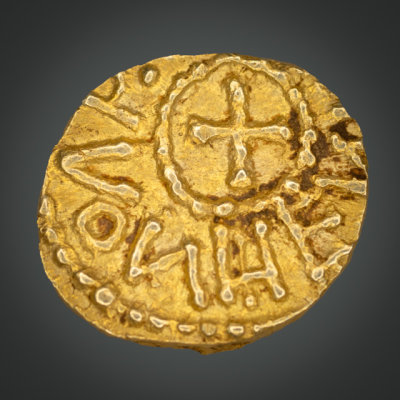
One of 6 examples of a Ciii York Group shilling, specific gravity indicates a gold fineness of c. 55%.
The first 5 letters of the inscription, read anticlockwise from the top and reversing the first letter, can be read as PAOLI (with L and I ligate). Then comes an unusual character with three verticals, an M, misread as an H by Abramson (Ms written like this can be seen on the York Anglian helmet), followed by an E, so giving us PAOLIME. There then seems to be another N or ligate LI, giving PAOLIMEN or PAOLIMELI. There remains space for a concluding US EP (as in the Cii variety), but the example found at Bawtry, South Yorkshire (EMC 1996.1001) shows a large D as the last letter. The Initial part of the inscription led Abramson (2019) to suggest that the coins are inscribed for Bishop Paulinus of York, from 627 to 633 when he fled south following Edwin's defeat by Penda and Cadwallon at the Battle of Hatfield. Paulinus was a member of the Gregorian mission sent in 601 by Pope Gregory I to Christianize the Anglo-Saxons. Abramson argued that the inscriptional Type C shillings were contemporary with Paulinus's time as Bishop of York. Oswald with Aiden brought back Christianity in the Celtic form and it wasn't until 664 that a new bishop (Chad) was installed at York.
Abramson, A. 2019. ENGLAND’S EARLIEST COINAGE WITH PARTICULAR REFERENCE TO THE YORK GROUP OF GOLD SHILLINGS. British Numismatic Journal volume 89, 2019, 1-18.
Copyright Ru Smith