


|
|
|
|
|
|
|
| |
| 30-Jun-2018 | paulROME©2018 |
Model A Ford Foundation Inc, (MAFFI)
Ford Model A Museum at the Gilmore Car Museum
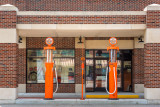
The gasoline pump has evolved over the years, beginning in 1885 with the first
kerosene pump manufactured by Sylvanus Freelove (S.F.) Bowser of Fort Wayne, Indiana.
The device was originally used to suck kerosene from barrels at general stores,
delivering the fluid to a customer’s portable metal can. The product would then be
brought home to fuel stoves, lighting fixtures, and possibly a horseless carriage
(if the customer was fortunate enough to afford one).
Though his pump was not originally designed to serve automobiles, by the 1890s,
Bowser noticed his invention of the kerosene pump could accommodate the horseless
carriages. He added a hose to his pump, and eventually a nozzle. Clerks would count
the number of cranks (pumps) they made with the handle to determine how many gallons
had been delivered into a customer’s tank (one crank would equal one gallon). Generally,
the clerk would also put an ear to the automobile’s tank to listen for the sound of gas
filling. Some clerks looked down the hole to see the height of the gas level, determining
when the customer’s tank was full. These methods proved to be both inefficient and dangerous.
By 1910, a clock face (to measure the amount of gasoline being pumped) was added to newly
manufactured pumps. The retailers who resisted the investment of a new pump outfitted their
crude, older pumps with accessorized clock faces. The demand for an even more precise way to
measure what was being purchased led to the design of a visible gas pump.
By the 1915s, some visible gas pumps stood upwards of 10-feet tall. The cylinders were marked,
by gallon, similar to a large science beaker. Beyond being a measurement device, these pumps
demonstrated the clarity of the gasoline; at the time, customers became increasingly aware that
pollutants in gasoline would harm their engine. Another function was to allow the customer to
quickly see which pump was ready to fill a gas tank, based on which cylinders were full. The
cylinders had a release valve attached, gravity feeding the tank of a customer’s vehicle when
released.
As more vehicles were on the road, crowded streets pushed curb-side pumps further back, and
forced the gasoline to be stored underground. The designers of gas pumps soon added an
aesthetic appeal to attract consumers to gas stations. With the addition of the clock face
and visible cylinder, the art deco movement took gas pumps by storm.
Through the 1920s, the colors and ornate designs of gasoline pumps stretched around the globe.
Everywhere, bright colored pumps full of gasoline were at every station. By the 1930s, the
visible pump decreased in size, giving way to a smaller version with a turbine inside. These
miniature, visible pumps were usually hanging off the side of a pump, with a hose connected
to the bottom, which fed into an automobile’s tank. These miniature cylinders were referred
to as “sight glasses”. The main reason for the smaller, visible cylinder was an increased
consumer confidence in the gas pump retailer. Consumers began to trust that the gasoline was
clear and the amount they paid for was accurate. It was the introduction of electric pumps
around the 1920s and 1930s that gave way to the ultimate precision of measurement, eliminating
the cylinder all together. An original, clock face pump can be seen at the Automobile Driving
Museum (the ADM (hyperlink: www.theadm.org)) in El Segundo, CA. This pump, likely from the early
20s, features red paint, a sight glass, and ornate globe atop the square stylized pump.
Due to a lack of street lights at night, globes not only helped advertise the gasoline’s
manufacturer, but also served as a beacon for travelers in desperate need of refueling.
These globes were added in early versions of the 1910s styled pumps. They were the last
decorative element of the gasoline pump to remain through the 1940s. As the cylinders
shrank into sight glasses, and then were all together removed, the globes remained. At
least five pumps with large, clear glass cylinders, ranging from the 1915s through 1930s,
are located at the ADM (hyperlink: www.theadm.org) in El Segundo, CA. The museum also
includes many 1930s through 1950s electric, computerized pumps with the original globes.
All Photos Copyright by Paul M. Rome