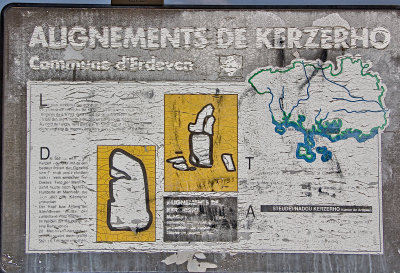
Just a short drive from Gavres are the famous ancient stones formations called Menhirs. Of course, I have to rely on Wikipedia to explain what they are:
A menhir is a large upright standing stone. Menhirs may be found singly as monoliths, or as part of a group of similar stones. Their size can vary considerably; but their shape is generally uneven and squared, often tapering towards the top. Menhirs are widely distributed across Europe, Africa, and Asia, but are most numerous in Western Europe; in particular in Brittany and on the British Isles. They originate from many different periods across pre-history, and were erected as part of a larger Megalithic culture that flourished in Europe and beyond.
The function of Menhirs has provoked more debate than practically any other issue in European prehistory. Over the centuries they have variously been thought to have been used by Druids for human sacrifice, were territorial markers, were elements of a complex ideological system, or functioned as early calendars.
The word menhir was adopted from French by 19th century archaeologists. It is a combination of two words found in the Breton language; men (stone), and hir (long). In Modern Welsh they are described as maen hir, or "long stone." In modern Breton, the word peulvan is used.