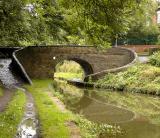
This is a rare kind of bridge designed as as a very elegant solution to a particular problem. It is known as a 'roving bridge', a 'snake bridge' or a 'changeline bridge'. Boats on England's canals were towed by horses which walked along a canalside path - the towpath. From time to time it was necessary for the towpath to change from one side of the canal to the other and some way had to be found to achieve this without disconnecting the tow line or causing it to tangle. Some said that this was to even out the 'wear' on the horse, though there were often other reasons. James Hyde Clarke ('Captain Clarke') was the land agent for Lord Ashton of Hyde and when this canal was built (around 1807), he required the builders to move the towing path to the other side of the canal, so that the local peasantry could not have easy access to Lord Ashton's land (and hence poach his game). The bridge that he insisted upon bears his name to this day.