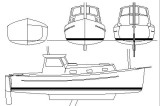
I am extremely excited and pleased to announce that plans for the Princess 28 are underway! I asked Graham if I could have the pleasure of announcing the P28.
I contracted with Graham Byrnes to design one for me. The cost was actually very reasonable for a custom design for two reasons. First, I will perform some of the layout and calculations under Graham's guidance. Second, Graham will make up some of the cost selling plans to others.
It is a pleasure working with Graham. And it's amazing what we can accomplish even though separated by 3,000 miles. Some of my ideas are pushing the limits a little and some of them have been reined in or dropped under Graham's wisdom and experience.
My desires for this design are a capable coastal and Caribbean cruising sailboat that is reasonably trailerable. Plus I want a simple and easy to handle rig like the cat ketch sailplan. (It is amazing how much expensive stuff is eliminated by the cat ketch rig when I look through the West Marine catalog.)
The lines below are the preliminary outlines for the hull (with Graham's permission). Only the hull outline and the waterline are shown to protect Graham's design. The lines and dimensions shown are to the inside of the hull to make it easier to build the frames for construction.
The hull will be strip-planked cedar with epoxy and glass inside and out. I may not actually be able to start construction for a while so I am beginning work on a model.
Here are some answers to some of the questions from the B&B Yachts Forum.
What will the beam be? 8’-6” The plan shows 8’-4” because the lines are drawn to the inside of the hull for convenience in building the frames.
And why strip cedar as opposed to ply construction? Will it be round hull? Graham highly recommended a round bilge profile particularly for long-term cruising/liveaboard conditions to reduce wave noise. He proposed cedar strips or foam core construction. At first, I chose foam-core but decided on cedar strip primarily because I would enjoy working with it much more than the foam core. I may use foam core in the deck and dodger laminations to reduce weight.
Tell me more. How much is the design weight parameters? The design weight will be governed by the accommodation design and ballast requirements. Part of my job is to calculate the weight of the accommodations. The final part of the design is the ballast keel, how much and how deep. I'm guessing a cruising weight about 5-6,000 lbs.
What more do you get with this design over a P-26? I imagine that the P28 will be at least 25% more living volume. A rough calc of the ratios of length, beam, and freeboard (28/26 * 8.5/8 * 3’4/3 = 1.27) shows the P28 is 27% larger. I am also pushing the design to create more headroom and living space by pushing the cabin height and width.
In the lower pic, the cockpit looks much smaller. Is that how the cabin is bigger? Another area that I am pushing for liveaboard space is by pulling the cabin bulkhead aft to the mizzen and offsetting the companionway to one side. In addition the interior headroom will be maximized by laminating the cabin top and sole without beams or floors.
I hope the design means your other boat now has a good new home, and life is settling in for you in your new location. Actually, Rosita is still not sold although I just listed her with a broker. I decided to proceed with the P28 design now as an interesting project that we look forward to building in the future. In the meantime, we can take our time to develop the ideas and build a model with time to let things simmer before committing to the full-scale project. We probably won’t start building until we move back east.
Through my own experiences I have become totally sold on the cat ketch concept for it ease of handling and total performance. I find my CS20 is very easy to singlehand, and quite maneuverable. It will be interesting to see how this scales up in a much bigger and heavier boat. I am also excited about how this boat will handle. It looks very fast and easily driven. I’m used to singlehanding a 28’ sloop and a 36’ ketch, so this boat should be a dream to singlehand.
I see some salty experience translated into the preliminary design. This does look like a good islands boat. I suspect the cat ketch concept will allow for accommodations that feel like a much larger boat, due to not requiring extensive bulkheads and structural reinforcement in the middle of the cabin compared to a sloop. I am a big fan of open interior plans. The layout will be similar to a 28’ cruising sloop I built from the hull and deck in the mid 80s. I had lots of comments that she felt much bigger inside than most 32 footers. You can see pics of Rosebud at www.pbase.com/sailrosita/rosebud
Cedar stripped construction will result in a beautiful hull - and a very nice view from inside the boat. I really enjoy cedar strip construction - it offers a most satisfying Zen for the builder. My feelings also and the biggest reason I chose it.
Presumably, the base 26 or 28 would be built the same way as the 22. Same type of plywood bottom. The strip plank, rounded bottom design opens lots of questions for me. The only way I've seen that done is with bulkheads supplemented with temporary lofted panels, or just lofted panels with bulkheads added after the hull is turned. These details will have to be worked out as the design develops. Hull construction would be over temporary station bulkheads. Thickness of the cedar strips will provide the local strength of the hull. I imagine that stiffening of the hull will be by constructing the interior furnishings after the hull is turned over. Appropriate use of plywood laminations and foam core will make the deck and cabin stiffer and lighter than equivalent fiberglass construction typical in most production boats.
Parker's cold molded designs have the same rounded bottom as above, but uses fore and aft tongue and groove lumber, supplemented with double diagonal plywood skins over that to the chine level, then plywood topsides to the sheer line. Extremely strong construction. But it seems to me like both types are harder to build than a plywood bottom. You can still put some gentle arc in a plywood bottom. Parker’s method also sounds very heavy. I’m thinking that strip-planking will actually be fairly simple once the stations are set up but may take a little more time than plywood construction. There will be no chines to stiffen with fillets and glass. Strip planking is a tried and true method for strong and light construction. This will be important for a fast and trailerable cruising boat.
What do you gain with the cedar strip arc bottom? If there an advantage I'm not aware of or is it an aesthetics or personal preference issue? The round bilge strip-plank construction should be slightly faster and lighter than hard-chine plywood. It will also be quieter and have less wave-slapping noise. Graham recommended it saying that plywood construction loses its advantages in larger boats. Ask Graham for more details.
In this version, is the CB still off centered or has it moved to the center? Lead keel? Because I am pushing the vertical limits of this design, we plan to have a lead ballast keel at about 2 foot draft. The actual keel design will be finalized after the hull, deck, cabin and accommodation weights are calculated. With a deeper draft keel, Graham suggested we can incorporate the centerboard into the keel to eliminate protrusion into the cabin required by shallow draft designs. A P28 design with shallower draft may still have the offset centerboard.
I know it adds some complexity, but on this big of a boat, is there any advantage in going to booms vs. sprits on the sails? I'm thinking from the standpoint of sail handling, reefing, etc. Good question. I will need to do some research on that. Although I can recall seeing designs for many of the large cat ketches with wishbone sprits. I hope to get away from booms because of the simplified rigging for sprits – no vang required to keep the boom from lifting. Also, less chance for contact with my head!
But as for the 28' design, I'm going to be one of those supplementing the design cost buy ordering a set of plans. I’m not sure when they might be available. I imagine that Graham is planning to offer the design as soon as he can; perhaps with details for more general preferences than my individual ones. I have a feeling it will be a popular design. I am certainly excited about it!
Will the mast be free standing or stayed? Will the mast be tabernacle mounted for easy dropping or this too much to expect when you get to a boat this size? The masts will be self-standing. I hope that they will be tabernacle mounted and fairly easy to raise and lower; manually or with a lifting rig. Graham has some experience with carbon fiber which may make this more feasible. Building them myself should be possible. This design will have to evolve later.
Garry, will the design be beachable at low tide and still stable? Ideal for the island hopping life. I would not plan to beach this boat (or any other) very often. In the right situation of course it could pull up to the beach but sand is rough on paint. And the motion of the water surface even for a firmly beached boat would cause a grinding action. Plus, with a 5-6,000 pound displacement and a retreating tide, the boat could get stranded. With a 2 foot keel I would expect that I can get into knee deep water and wade in if I want to. Normally I would anchor in a little deeper water to account for tidal variations and take the dinghy in.
This sounds like a great boat. Is it feasible to add 6 more inches of headroom space? Kevin, I'm 6'3" and would love to get 6 more inches of headroom but we are pushing it at 5'9". That's one of the trade-offs for a fairly light displacement 28 foot boat that is reasonably trailerable. To add any more freeboard and cabin height would distort the boat and add more ballast. I can stretch and straighten up in the companionway or on deck. I do plan to have a bimini top with 6'3" headroom over the cockpit.
In 1985, I finished 28 footer from the hull and deck and pushed the cabin sole down to get 6'3". She was a great boat but not what I would consider trailerable. She weighed about 9,000 lbs with 9’ beam and drew 4 ft (another version drew 3 ft with a centerboard). I lived on her for three years and loved that boat.
More on mast and boom: I spoke to Graham today for some advice on the model. We also talked about the masts and booms. Graham feels the masts will be easily raised with the tabernacles by simply walking forward and pushing them into position. Especially if they are made with carbon fiber. He will keep similar proportions to previous models in relation to the mast vs. hull length since this has worked well in the past and it works well for trailering. The sails will likely be full battened with plenty of roach to get good sail area while keep the center of effort low; plus there will be less flogging when reefing and raising.
As for booms, Graham feels they cancel many of the advantages of the cat ketch rig. The vang would prevent free rotation around the mast. The vang would carry a lot of tension and the sheets would carry a lot more tension and require more blocks to get a safe load level.
I may want to consider wishbone booms instead of straight sprits for these large sails. But either one would be easily rigged for reefing. Graham described his reefing technique and it sounds relatively simple. For stowing, the sails can be dropped into a "hammock" under the boom and then stuffed into a bag similar to a jib bag. I would rather do this than leave them in the hammock except for short periods (overnight, etc.).
I see you have a pilot house and a way to keep the hatch from getting things wet down below. The question is, do u have enough beam for the sail plan necessary to make her a nice sailing vessel? The beam, of course, is limited by trailer load width restrictions to 8'6". Graham's lines show about 7'6" to 7'8" beam at the waterline. The lines also carry the beam well aft. So it looks to me like the lines are designed to maximize beam within the restrictions.
The sailplan will be a cat ketch rig with the center of effort kept low by carrying full batten main and mizzen. The hull looks like it will be fast and easily driven. The amount of ballast will be determined after everything else is accounted for. Graham will be doing stability curves.
What is the distance between the cabin side and the edge of the deck? It will be around 7-9 inches. I deliberately asked for that to improve the interior headroom and expansiveness. I had to push Graham on this so he may be offering plans with wider sidedecks. However, the wider cabin does provide higher ultimate stability if the boat is laid over.
I will not be installing lifelines. I really don't think they are effective. And they are big trip hazards and toe stubbers. I think they are more likely to cause a fall than actually prevent one. The sidedeck path will be clear except possibly for a midship cleat and I will try to find a way to keep it in the cap-rail or maybe use one of those removable cleats.
I will install a very sturdy handrail at least 6" tall somewhat inboard on the cabin top to provide a solid handhold and tether connection rail. Plus I will have a toerail at least 3" high. I will feel a lot safer hanging onto a solid handrail than depending on the typical lifelines and the typical grab rails.
Garry, I think that is a great trade off. Without the lifelines to get in your way it will be plenty. Does the toe rail get higher as you go forward? No I think there is plenty of sheer and I want good consistent footing so I would keep it at the same height, 3-4".
I know that it is early and all we have seen so far is a sketch but what are your plans for forward cleats? Will you have hawse pipes in the side for the dock lines to go thru? I would like to locate the cleats as near the edge of the deck as possible to eliminate hawse pipes or chocks and minimize chafe. I will add reinforcing as needed to get the cleats forward and near the edge. The toe rail will stop about 18" from the bow so it won't interfere with dock lines etc.
Is the pilot house going to be built out of ply or something else? I'm thinking a sandwich of ply and rigid foam to keep it stiff and light.
Additional discussion: For our use we want it all! We anticipate locating in Jacksonville, FL. The boat would be used locally in St. Johns River and we may even get a slip there. The trailer allows pulling her out for bottom cleaning and maintenance at our own choosing with minimal cost. We also have the freedom to trail down to the Keys, across to the west coast of FL, or up to Georgia and the Carolinas easily. Or we could plan longer trips to the northeast and Maine, the Great Lakes, the Texas coast, or even the Baja and coast of Mexico!
We also want to feel comfortable and safe for coastal cruising and island hopping for extended periods. This boat will probably carry the maximum ballast according to Graham's design calcs.
Our situation means that we won't be retiring or dropping out of the working world any time soon. So the more flexibility we have the more adventure we can have.
As for trailering size, we are pushing the limits. The legal and practical limit appears to be 8'-6" although others tell me they have hauled wider boats without trouble. Within this limit, Graham has pushed the waterline beam to the maximum reasonable at about 7'-8". I doubt that exceeding the 8'-6" beam will increase the waterline much.
I scale the height from keel to hard dodger at 9'-4". The mizzen tabernacle would add about 4" and the trailer would add about 18-20". So I figure the maximum height will be about 11'-6" or less with the hard dodger. (Without the dodger the height would be about 10 feet.) So I don't think the height will be an issue.
Of course we could trailer an even larger design especially if we planned only to trail her a few times a year. But we would be giving up some flexibility that seems important to us now. And I'm not sure that we would gain any more of what we wanted. Boats are just one huge pile of compromises!
I like the feel of this boat. It will move easily and be easily handled. Graham is certain that we will be able to raise the masts by hand; especially if we build carbon fiber spars.
But then, once the 28 ft design is complete, scaling the design up to 30' with 9 ft beam or even 32 ft with 9'-6" beam sounds tempting.