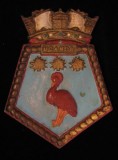
Plaster crest with red ostrich proper with three leaves resembling maple leaves. These are gold on a green background. Gold rope twist border with crown on top.
Narrative: As HMS Uganda, the name of her Cruiser class, she was completed January 3, 1943 at Vickers Armstrong Ltd., Newcastle-on-Tyne. After working up with the home fleet she joined Plymouth Command in April for operations in the Bay of Biscay and the English Channel. In July she joined the 15th Cruiser Squadron, Meditterranean Fleet, as part of Force "K". She was badly damaged by German glider bomb on September 13, 1943, while supporting Allied landings at Salerno, Italy. She arrived at Charleston, South Carolina, in November for a year of repair work. Presented to the RCN the ship was commissioned the HMCS Uganda on October 21, 1944 and in November returned to the U.K. for further modifications. She left in january 1945, for the Pacific via the Suez Canal to join the 4th Cruiser Squadron, British Pacific Fleet. In April she joined Task Force 57 in the Okinawa area and was thereafter principally employed in screening the Fleet's aircraft carriers operating against Japanese airfields in the Ryukyu Islands. On June 14, she participated in the bombardment of Truk and in July supported carrier operations against Tokyo. She left the Fleet late in July and arrived at Esquimalt on August 10 for refit. Uganda spent the rest of her career as a training ship, having been renamed HMCS Quebec on January 14, 1952. Paid off on June 13, 1956, she arrived at Osaka Japan on February 6, 1961 to be broken up.