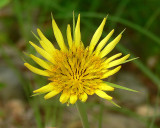
The Goatsbeards or Salsifies are the genus Tragopogon of flowering plants within the family Asteraceae. They include
the vegetable called salsify as well as a number of common wild flowers, some of which are usually regarded as weeds.
The Yellow Goatsbeard opens early in the morning and closes around noon or on cloudy days.
There seems to be conflict in identification when lookups are compared. Judging from images on wikipedia,
this plant shown here appears to be "Western Salsify" http://en.wikipedia.org/wiki/Western_Salsify and not
the generally commoner Meadow Salsify, T. pratensis, http://en.wikipedia.org/wiki/Meadow_Salsify
This is based on the longer bracts and stem swelling just below flower head visible in these images.
Because Western Salsify is a widespread plant, it has a large number of alternative common names.
They include Western Goat's Beard, Wild Oysterplant, Yellow Salsify, Yellow Goat's Beard, Meadow
Goat's Beard, Goat's Beard, Goatsbeard, Common Salsify, or Salsify. Some of these are also, or more
commonly, used for other species, and are better avoided. A synonym, Tragopogon major, may also be
encountered. These are considered invasive plants as they are not indiginous to North American continent.
The Rise of New Species
Goatsbeard are one example of when speciation has been observed. In the early 1900s, humans introduced
three species of goatsbeard into North America. These species, the Western Salsify (T. dubius), the
Meadow Salsify (T. pratensis), and the Oyster Plant (T. porrifolius), are now common weeds in urban
wastelands. In the 1950's, botanists found two new species in the regions of Idaho and Washington,
where the three species overlapped. One new species, Tragopogon miscellus, is a tetraploid hybrid
of T. dubius and T. pratensis. The other species, Tragopogon mirus, is also an allopolyploid, but its
ancestors were T. dubius and T. porrifolius. These new species are usually referred to as "the Ownbey hybrids"
after the botanist who first described them. The T. mirus population grows mainly by reproduction of its own
members, but additional episodes of hybridization continue to add to the T. mirus population.
[sources: wikipedia and Audubon Society Field Guide to North American Wildflowers.
for further info: http://en.wikipedia.org/wiki/Jack-go-to-bed-at-noon
for major (and interesting - IMHO) information on the genus see: http://en.wikipedia.org/wiki/Salsify
3d7151_ 661_NI.JPG
All images © 2003-2018 by dick Burwell. Do not copy, download, or link. All rights reserved. (TinEye Tracking in Use)