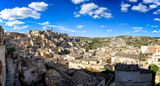
The old town Sassi district in Matera, the region of Basilicata, Southern Italy.
Panorama made of 7 images.
The city of Matera lies on the right bank of the Gravina river. Matera is the capital of the Province of Matera in the region of Basilicata, in Southern Italy. With a history of continuous occupation dating back to the Palaeolithic (10th millennium BC), it is renowned for its rock-cut urban core, whose twin cliffside zones are known collectively as the Sassi. The Sassi consist of approximately twelve levels spanning the height of 380 m, connected by a network of paths, stairways, and courtyards (vicinati). The medieval city clinging on to the edge of the canyon for its defense is invisible from the western approach. Yet it was only at the turn of the twentieth century that the Sassi were declared unfit for modern habitation. The government relocation of all their inhabitants to new housing in the Piano district of Matera was carried out between 1952 and the 1970s.
A new law in 1986 opened the path to restoration and reoccupation of the Sassi, this time – as noted by the architectural historian Anne Toxey – for the benefit of the wealthy middle class. The recognition of the Sassi, labelled la città sotterranea ("the underground city"), together with the rupestrian churches across the Gravina as a UNESCO World Heritage Site in December 1993 has assisted in attracting tourism and accelerated the reclaiming of the site. In 2019, Matera was declared a European Capital of Culture.