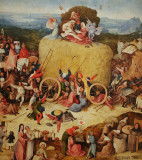
Hieronymus Bosch (Jeroen van Aken, ca 1450-1516), The Haywain (1500-1502), triptych, central panel.
Prado Museum, Madrid.
The central panel presents a great haywain trundling across a vast landscape and followed by the great of this world on horseback, including an emperor and a pope. The lower classes – peasants and burghers as well as nuns and clergy – snatch tufts of hay from the waggon or fight among themselves for the handful they have already managed to grab. Appearing high overhead and surrounded by a golden glory, Christ seems clearly distant from the scene below. Except for an angel kneeling and praying on top of the haystack, no one notices the Divine Presence, and above all, no one notices that the waggon is being pulled by devils towards hell and damnation, namely in the direction of the right wing.
In the fifteenth century, hay was a traditional symbol of human frailty as well as of the worthlessness of all worldly gain, hay being considered a commodity of low value.
In The Haywain, Bosch focuses on the desire for worldly gain, the deadly sin of Avarice, which inevitably leads to discord, violence and even murder, all of which are depicted in narrative sequences in the open space before the hay cart. If the princes and prelates complacently jog along behind, holding themselves aloof from the struggle of the lower classes, simply because the whole of the haystack is, as it were, already in their possession, in fact, they make themselves in their conceited complacency guilty of the sin of Pride.
Avarice also leads people to cheat and deceive. The man wearing a tall hat and accompanied by a child at lower left is most likely a false beggar. The quack physician in the centre has set up his table with jars and publicity charts designed to impress, while he is simulating a faithful diagnosis of the woman’s disease, the purse at his side stuffed with hay alluding to his ill-gotten gains. Several nuns at lower right push hay into a large bag, supervised by a seated gluttonous monk.
The presence of kissing lovers on top of the haystack illustrate the pleasures of flesh, the sin of Lust. A class distinction may be observed between the rustic couple kissing in the bushes behind and the more elegantly dressed group making music. However, their music is that of the flesh, while a devil nearby assists by piping some lascivious tune through his trumpet nose, at the same time luring everyone’s attention away from the angel praying at the left.
For details, see next pictures