


|
|
|
|
|
|
|
| |
| 10-AUG-2010 | Christine Hanrahan |
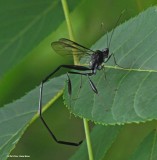
This wasp is distinctive in flight, with its long ovipositor held straight out behind. These wasps are often found in lawns because they are parasites on the larvae of the June beetle (the white grubs that destroy lawns). Thus, anyone with a lawn should welcome these guys, or in fact, these gals, as you will almost never see a male of the species. And by the way, these wasps do not sting! That long projection trailing out behind is the female's ovipositor (for egg-laying).