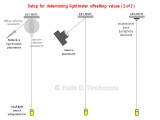
Reasoning for using this particular set up for light meter measurements:
-A snooted source will prevent much possible secondary illumination of the test card and dome receptor from adjacent walls, preventing much secondary specular reflections from the test card and also preventing the dome to be lit off-axis.
-Incident meter dome on axis to the source is a very simple, straightforward and reproducible way of lighting, taking away any complications of the cardioid dome’s angular response, while allowing the use of the calibration constant as C = 340.
-Moreover, the use of a small size source adequately far means that is test card is uniformly lit while the range of angle with specular reflections is rather confined, letting a wider safe range of angles for placing the spot meter and the camera to measure and record the diffused value –true tone- of the test card.
-Placing the incident light meter lumidisk mode receptor perpendicularly to the test card surface provides the best possible approximation of the the true illumination that the test card receives. An exact measurement of illumination would normally require a true flat receptor, which is not available.
It should be noted that when measuring with the spot meter, a safe way to be sure that we are indeed measuring the diffused value is that the reading will remain unchanged as we move to more oblique angles, getting away from specular components. This is because the apparent brightness (luminance L) of a perfect diffuser – a Lambertian surface – is not a function of the angle or distance we observe or measure it, a paramount physical feature which constitutes the principle of operation of all reflective meters.
By the way, the other critical physical feature on which the operation of light meters is based is the fact that the image luminance created on film/sensor after the lens, is affected not by the absolute diaphragm diameter D on the lens, but by the ratio f/D, which gives the f-number, as the meter equations suggest as well.