From Turkish text in museum, Google translated:
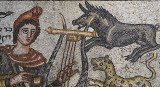
Orpheus is known as a poet in ancient legends, and the mystical movement called Orphism is attributed to him. His lyre enchants wild animals, and his melody even conquers death. The mosaic, depicting Orpheus taming wild animals with his lyre, features two Syriac inscriptions, one to the left of Orpheus's head and the other at his feet. The three-line inscription to the left of Orpheus's head reads "brsgd rswp' rsp" (Bārsaged, mosaic master, made the mosaic). The inscription and mosaic are quite significant as they are the only examples among the mosaics of Şanlıurfa (Edessa) where the mosaic master signed their work. The six-line inscription at Orpheus' feet reads: "byrh nysn šnt hmšm whmš 'n' pp' br pp' bdt ly bytmškb' hn' ly wlbny wlyrty bryk mn dnhz' wnbrk" (April, year five hundred and five, I, Pāpā, son of Pāpā, built this eternal resting place for myself, for myself and for my children and for my heirs. Blessed be whoever sees it and prays to it). The date 505 found on the mosaic belongs to the Seleucid calendar used in Şanlıurfa (Edessa). Based on this, the mosaic is dated to 194 AD.
The mosaic was brought to our country from the Dallas Museum of Art on December 6, 2012, through the initiatives of the General Directorate of Cultural Heritage and Museums of the Ministry of Culture and Tourism.